
Nevada DMV Motorcycle Practice Test 58
- Questions25
- Correct to pass20
- Passing score80%
- Minimum age15 years 6 months
-
1. During a pre-ride check, what should the throttle do when it is released?
Show answer
Answer A: Snap back to the closed position on its own
A throttle that does not close by itself can leave the engine running fast when the rider expects it to slow, so a sticking cable must be repaired before riding.
-
2. May you stop briefly across the sloped ramp that joins the sidewalk to the street at a corner?
Show answer
Answer B: No, that ramp must stay clear for people using wheelchairs
A curb ramp is the only way many people can get from the sidewalk to the crosswalk, so blocking it even briefly is prohibited.
-
3. What happens in Nevada if an applicant fails the DMV-administered motorcycle skills test twice or more?
Show answer
Answer B: Future motorcycle instruction permits are permanently denied, and only a certified course can lead to a Class M license
Nevada permanently denies future motorcycle instruction permits after two or more failures of the DMV skills test, leaving a certified motorcycle safety course as the only route to a Class M license.
-
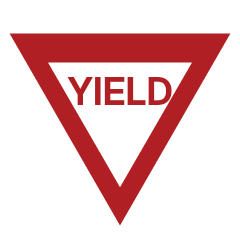
4. Apart from other vehicles, who else must a driver let go first at this sign?
Show answer
Answer A: Pedestrians and cyclists already in or entering the crossing
The duty to give way covers every road user who has the right of way at that point, including people walking or cycling across the driver's path.
-
5. You are stopped in traffic at a red light when an ambulance comes up behind you with its siren on. What is the correct action?
Show answer
Answer D: Stay put until you can move aside legally and safely
You must not run a red light or make an unsafe move to yield; wait, then pull to the side once the way ahead lets you do it safely.
-
6. What is the correct order of a pass on a two-lane road?
Show answer
Answer A: Check ahead and behind, signal left, move out, accelerate past, signal right and return
A pass begins with the decision that the road is clear and ends with a signaled return, and each step warns other drivers before the vehicle moves.
-
7. Where do the greatest number of collisions involving motorcycles occur?
Show answer
Answer D: At intersections
Intersections concentrate crossing and turning paths, and the most common single event is a car turning left across the path of an oncoming motorcycle.
-
8. How much of a traffic lane is a motorcycle entitled to use?
Show answer
Answer D: The full width of the lane
A motorcycle is entitled to the full lane, and riders move within it to stay visible and to avoid surface hazards, so drivers should never try to share a lane with one.
-
9. A yellow diamond showing two vertical arrows, one pointing up and one pointing down, warns that
Show answer
Answer A: the road ahead carries traffic in both directions
The two-way traffic sign warns that the roadway ahead is not divided and that vehicles will be coming from the opposite direction.
-
10. A car is passing you on a two lane road. Which lane position is generally best while it goes by?
Show answer
Answer A: The center portion of your lane
The middle of the lane keeps distance from the passing vehicle and its mirrors while leaving room on the other side if the rider needs it.
-
11. A broken white line separates your lane from the lane on your right. What does it permit?
Show answer
Answer C: Changing lanes when it is safe to do so
A normal broken white line marks a boundary between lanes traveling the same way that road users may cross when it is safe.
-
12. Why is the road often most slippery during the first few minutes of rain after a long dry spell?
Show answer
Answer C: Oil and dust on the surface mix with the water into a slick film
Oil drippings and road dust build up on dry pavement, and the first light rain lifts them into a slippery film before heavier rain washes it away.
-
13. You reach a T intersection where the cross street has a ONE WAY sign pointing to the right. What may you do?
Show answer
Answer B: Turn right only, because the street carries traffic in that direction
The arrow shows the only direction traffic may travel, so the only legal movement from the terminating road is a right turn.
-
14. Which sign tells you that the vehicles ahead are part of a funeral procession?
Show answer
Answer C: Headlights burning in daylight, with small flags or markers on the vehicles
Processions are normally identified by daytime headlights, hazard lights and flags or windshield markers, not by emergency lights or sirens.
-
15. You are approaching the entry of a roundabout and a pedestrian is crossing the marked crosswalk on your approach lane. What must you do?
Show answer
Answer D: Stop before the crosswalk and let the pedestrian cross
Roundabout crosswalks sit a short distance back from the yield line, and drivers must yield there before they ever reach the circulating lanes.
-
16. There is a stop sign but no stop line and no crosswalk. Where must you stop?
Show answer
Answer A: Before entering the intersection, where you can see cross traffic
With no line or crosswalk, stop before you enter the intersection at the point where you can see traffic on the cross street.
-
17. Why is following distance measured in seconds rather than in car lengths?
Show answer
Answer A: Because a time gap automatically grows with speed, while a fixed number of car lengths does not
A gap counted in seconds keeps the same margin of reaction time at any speed, whereas a fixed number of car lengths becomes far too small as speed rises.
-
18. Two vehicles reach a four-way stop at the same moment from adjacent roads. Who should go first?
Show answer
Answer A: The driver on the right
When two drivers stop at a four-way stop at the same time, the driver on the left yields to the driver on the right.
-
19. A driver waiting to turn left appears to be looking straight at you. What should you assume?
Show answer
Answer C: That the driver may still not have seen you, and may turn across your path
Drivers look toward motorcycles without registering them, so eye contact is not evidence that the rider has been seen and no plan should depend on it.
-
20. You park at the roadside on a hill, facing downhill. What keeps the motorcycle from rolling away?
Show answer
Answer D: Leaving it in first gear with the front wheel turned toward the curb
A motorcycle has no parking brake, so the transmission left in gear stops the wheel turning and the front wheel turned into the curb blocks any roll.
-
21. Driving at night you notice that the raised markers along the line beside you are throwing back red light. What does that tell you?
Show answer
Answer C: You are facing traffic and must get off that roadway
Red retroreflection is shown only toward traffic that should not be there, so a red return means the vehicle is heading the wrong way.
-
22. A sign with a brown background and a white legend guides road users to
Show answer
Answer B: parks, campgrounds and other recreational or cultural sites
Brown is reserved for recreational and cultural interest area signing, such as parks, historic sites and scenic areas.
-
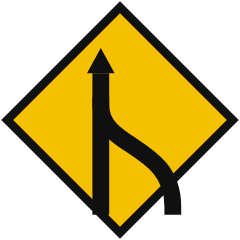
23. What does this sign warn a driver about?
Show answer
Answer A: Traffic from another roadway will enter the same lane ahead
Two traffic streams come together into one lane beyond this point, so drivers on both roadways have to adjust speed and spacing to fit together.
-
24. A row of solid white triangles points toward you across your lane. What does it mark?
Show answer
Answer A: The place to yield to traffic or people ahead
A yield line of triangles shows drivers exactly where to give way, and it is used at roundabouts and at midblock crosswalks.
-
25. A person in a wheelchair is traveling in the roadway because the sidewalk is blocked by construction. What should you do?
Show answer
Answer B: Pass slowly with plenty of room, or wait
A blocked sidewalk leaves the person no choice but the road, and a chair cannot move aside quickly, so pass wide and slow or wait for room.