
Nevada DMV Motorcycle Practice Test 57
- Questions25
- Correct to pass20
- Passing score80%
- Minimum age15 years 6 months
-
1. You are traveling in the same direction as a funeral procession and want to get ahead of it. What should you not do?
Show answer
Answer B: Driving in between the vehicles of the procession
Most states prohibit driving into or through a funeral procession, and cutting into the line leaves the drivers behind with no lead vehicle to follow, so go around only where passing is permitted.
-
2. What is the correct body position for riding over a bump or an obstacle?
Show answer
Answer B: Rise slightly off the seat with your weight on the footrests, absorbing the shock with knees and elbows
Coming slightly off the seat lets your legs and arms work as extra suspension instead of transferring the impact through your body and the handlebars.
-
3. Why should you make sure your turn signal has stopped flashing after a lane change?
Show answer
Answer A: A signal left flashing tells other drivers that you intend to move again
Other drivers act on your signals, so one that is left on gives them false information about what you are about to do.
-
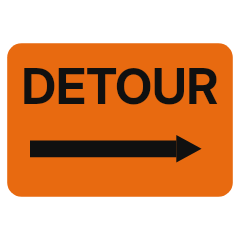
4. Which of these is true of the roadway a driver is being sent onto here?
Show answer
Answer D: Its own signs, signals and speed limits govern for the whole way around
The alternate route is an ordinary public road, so every control posted on it governs as usual; being sent that way grants no extra priority and no relief from the limits in force there.
-
5. You are on a city street with two lanes in your direction, cars parked along the curb and driveways every few yards. Which lane is usually safer?
Show answer
Answer B: The lane farther from the curb, away from opening doors and vehicles pulling out
Most of the hazards on such a street come from the curb side, so the inside lane gives you more space and more time to react.
-
6. What does a marked crosswalk tell a driver approaching a corner?
Show answer
Answer D: Where pedestrians are expected to cross and must be given way
Crosswalk markings show pedestrians where to cross and warn drivers to yield to anyone using the crossing.
-
7. Why is hearing protection recommended even under a full face helmet?
Show answer
Answer D: Long term exposure to wind and road noise can cause permanent hearing damage
Airflow around a helmet produces high noise levels, and good hearing protection lowers that noise while still letting the rider hear horns and sirens.
-
8. What should you confirm about your saddlebags before riding away?
Show answer
Answer A: That both are latched shut and neither is overloaded
An unlatched or overstuffed bag can swing open or sag into the rear wheel or the exhaust, either of which can wreck the machine's handling at once.
-
9. A driver stopped on suspicion of impaired driving refuses to take a chemical test. What happens?
Show answer
Answer D: A license penalty follows for the refusal itself
Under implied consent, holding a license means agreeing to testing, so a refusal brings its own suspension separately from anything the court decides.
-
10. Why do streetcar or light rail rails set into a street deserve extra care from a rider?
Show answer
Answer B: The groove alongside the rail can catch a front tire crossed at a shallow angle
The groove beside an embedded rail is just wide enough to trap a motorcycle tire, so cross rails at as steep an angle as your lane allows.
-
11. A rider notices scalloped, uneven wear across the front tire. What does that suggest?
Show answer
Answer C: A suspension or wheel bearing fault that should be inspected
Cupped or scalloped wear normally points to worn fork components or loose wheel bearings letting the tire bounce as it rolls.
-
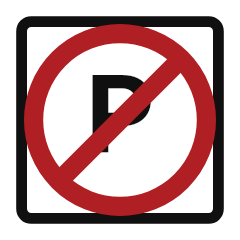
12. A driver leaves the vehicle at the curb where this sign is posted and walks away for two minutes. Is that allowed?
Show answer
Answer B: No, leaving the vehicle unattended there is prohibited whatever the length of the absence
Walking away leaves the vehicle parked, and the prohibition holds regardless of how long the driver is gone or whether the engine is left running.
-
13. How should your following distance change in heavy rain?
Show answer
Answer D: It should be increased well beyond what you use on dry pavement
Wet pavement lengthens stopping distance and rain cuts visibility at the same time, so a larger gap gives you the extra seconds needed to see a problem and stop for it.
-
14. Your vehicle breaks down on a busy highway. What is the safest course of action?
Show answer
Answer D: Get it as far off the roadway as possible, switch on the hazard lights and keep clear of the traffic lanes
A vehicle left in or beside a travel lane is a hazard, so move it well off the road, make it conspicuous with hazard lights and keep yourself away from passing traffic.
-
15. A yellow diamond reading DIP warns a driver about
Show answer
Answer A: a short, sharp depression in the road surface
A dip is an abrupt low point that can jolt a vehicle or scrape its underside, so speed should be reduced before reaching it.
-
16. A bicycle symbol topped by two chevrons is painted in the middle of a travel lane. What does that marking indicate?
Show answer
Answer D: Bicyclists share the lane with motor vehicles and may ride away from the curb
A shared lane marking shows drivers where bicyclists are likely to ride in a lane used by both bicycles and motor vehicles.
-
17. A NO LEFT TURN sign carries a plaque reading 7 AM TO 9 AM MON TO FRI. What does the assembly mean?
Show answer
Answer A: The turn is banned only during those hours on those days
A time plaque limits the restriction to the periods shown, so outside those hours and days the left turn may be made normally.
-
18. You are driving through a residential area where parked cars hide the side streets. What is the safest approach?
Show answer
Answer C: Slow down and cover the brake as you pass each opening
Where parked vehicles hide side streets and driveways, lower speed and a covered brake buy the time you lose in sight distance.
-
19. You are backing out of a space in a parking lot. Who has the right of way?
Show answer
Answer D: Traffic already moving in the lane, and pedestrians walking behind you
A driver backing out must yield to vehicles and pedestrians already using the lane, because backing is the movement with the poorest view.
-
20. Which statement about standard drinks is correct?
Show answer
Answer C: A standard serving of beer, of table wine and of distilled spirits each contain about the same amount of pure alcohol
Roughly 12 ounces of regular beer, 5 ounces of table wine and 1.5 ounces of 80 proof spirits each contain about the same amount of pure alcohol, so the type of drink does not change the effect.
-
21. You are riding along a street lined with parked cars. What is the safest approach?
Show answer
Answer D: Move away from the parked cars, slow down, and watch for doors and people
Doors open, drivers pull out and pedestrians step between vehicles, so extra space and a lower speed give the rider time to see and react.
-
22. What is the main source of the noise that damages a rider's hearing?
Show answer
Answer A: Wind turbulence around the helmet, which rises sharply with speed
Wind noise around a helmet is loud enough at highway speed to cause permanent hearing loss over time, which is why earplugs are recommended even on quiet machines.
-
23. How should a rider use a motorcycle fitted with antilock brakes in an emergency stop?
Show answer
Answer D: Apply firm, steady pressure to both brakes and keep it there
An antilock system releases and reapplies pressure far faster than a rider can, but only while the rider keeps holding the brakes on.
-
24. What should a passenger do when the motorcycle leans into a curve?
Show answer
Answer A: Lean with the operator, staying directly behind them
A passenger who leans with the operator lets the motorcycle follow its natural line, while leaning against the lean fights the operator's control inputs.
-
25. You are driving through patchy fog on a highway. What should you be ready for?
Show answer
Answer B: Sudden dense banks where visibility drops within a few car lengths
Patchy fog can go from clear to nearly blind in a moment, so keep your speed low enough that a sudden bank does not leave you without room.