
Nevada DMV Motorcycle Practice Test 1
Test 1 of 6. Pick an answer for each question to see if it is right and why; your score appears at the end. You need 20 correct answers to pass, the same ratio as the real Nevada test.
- Questions25
- Correct to pass20
- Passing score80%
- Minimum age15 years 6 months
-
1. What must a Nevada rider under 18 do to complete a motorcycle instruction permit when a safety course is offered within 30 miles of home?
Show answer
Answer D: Log 50 hours of supervised riding and complete a certified safety course
A Nevada rider under 18 must hold the permit at least six months, log 50 hours on the DMV drive log and complete a certified motorcycle safety course; with no course within 30 miles, an extra 50 hours and the DMV skills test are required instead.
-
2. How long is a Nevada motorcycle instruction permit issued to a 16-year-old valid?
Show answer
Answer B: One year, but it expires on the rider's eighteenth birthday
A Nevada motorcycle instruction permit issued to a rider aged 15 and a half but under 18 is valid for one year and may be renewed, but it expires when the rider turns 18.
-
3. How can a Nevada rider obtain a Class M license without taking the DMV written and skills tests?
Show answer
Answer C: By completing a certified motorcycle safety course and bringing the certificate of completion to a DMV office
Nevada accepts a Motorcycle Safety Foundation certified course in place of the DMV written and skills tests, and the DMV will accept the certificate for up to one year after completion.
-
4. A driver is following you far too closely and you have a turn coming up. How should you slow down for it?
Show answer
Answer B: Signal early and slow gradually well before the turn
Early signals and gentle braking give a tailgater the time and distance they have failed to leave for themselves.
-
5. Why do watering eyes matter so much to a rider?
Show answer
Answer D: Blurred vision delays the moment you see and react to a hazard
Wind makes unprotected eyes water, and even a brief loss of clear vision at road speed costs you the distance you need to react.
-
6. Your light turns green, but a vehicle from the cross street is still finishing a turn inside the intersection. What should you do?
Show answer
Answer B: Wait until that vehicle has cleared the intersection
A green indication lets you proceed only after yielding to pedestrians in the crosswalk and to vehicles already lawfully within the intersection.
-
7. In a work zone a flagger is directing traffic in a way that conflicts with the posted signs. Whom do you follow?
Show answer
Answer B: The flagger's directions
A flagger controls traffic through a work area that changes from day to day, and those instructions take precedence over the fixed signs and markings in that zone.
-
8. A piece of farm machinery ahead of you is wider than its own lane. What should you do?
Show answer
Answer C: Hold back until you can see far enough to pass safely
Wide equipment leaves no gap inside the lane and may use part of the other side, so a pass needs a long clear view of the road ahead.
-
9. Why does a passenger often feel the cold sooner than the rider on a long ride?
Show answer
Answer B: A passenger sits still and does not have the fuel tank to shelter behind
The rider has a screen or a tank to break the wind and is busy operating the machine, while a passenger sits exposed and inactive and chills faster.
-
10. Which facility does this sign direct a traveler toward?

Show answer
Answer B: A hospital offering emergency care
This is the standard marker for medical care, used to lead a traveler to a hospital where emergency treatment is available.
-
11. Traffic is heavy and you find yourself riding level with a car in the next lane. What is the problem with staying there?
Show answer
Answer B: You sit in the driver's blind spot, so a lane change could hit you
Motorcycles disappear easily in a blind spot, so adjust your speed to ride ahead of or behind the other vehicle instead of beside it.
-
12. You are the first to arrive at a crash on a rural road. What should you do first?
Show answer
Answer C: Park well clear of the scene, put on your hazard lights and call for help
Getting trained help on the way and keeping the scene visible does more good than anything an untrained bystander can do.
-
13. Traffic is backed up beyond a railroad crossing. When may you start across the tracks?
Show answer
Answer B: Only when there is room for your whole vehicle on the far side
Never enter a crossing you cannot clear; a vehicle stopped on the tracks in a queue has nowhere to go if the signals start.
-
14. You are stopped at a stop sign where your road ends at a two-way through street and you plan to turn left. What must you yield to?
Show answer
Answer B: Traffic from both directions and any pedestrians crossing
A left turn from the stem of a T crosses the near lane and joins the far one, so you give way to traffic in both directions and to pedestrians.
-
15. You are hosting a party and a guest who has been drinking wants to drive home. What should you do?
Show answer
Answer D: Stop serving and arrange a ride or a bed
Only time removes alcohol, so a host who wants to prevent a crash has to remove the driving, not try to speed up sobering that cannot be sped up.
-
16. After a crash, what information should you exchange with the other driver?
Show answer
Answer B: Name, address, driver license, vehicle registration and insurance details
Identification, registration and insurance information are what the other party and the insurers need. Sensitive financial details are never required.
-
17. A pedestrian is waiting to cross ahead of you and you have slowed down. What helps most?
Show answer
Answer D: Making eye contact, so that you both know you have seen each other
Eye contact confirms that you have seen each other; waving someone across can send them into the path of another vehicle.
-
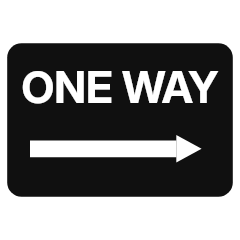
18. A driver disregards this sign and turns so as to travel against the direction it establishes. What is the immediate danger?
Show answer
Answer D: The driver will face traffic head on, because every lane comes the other way
Turning against the established direction puts the vehicle nose to nose with all the traffic on that street, which is why the mistake has to be corrected at once.
-
19. You are on a city street with two lanes in your direction, cars parked along the curb and driveways every few yards. Which lane is usually safer?
Show answer
Answer B: The lane farther from the curb, away from opening doors and vehicles pulling out
Most of the hazards on such a street come from the curb side, so the inside lane gives you more space and more time to react.
-
20. What are the minimum liability coverage amounts required in Nevada?
Show answer
Answer D: $25,000 for one person, $50,000 for two or more persons, and $20,000 for property damage
Nevada requires 25/50/20 liability coverage, and the policy must be written for Nevada and verified electronically by an insurer authorized in the state.
-
21. Once you are moving, which way of using a navigation device costs you the least attention?
Show answer
Answer B: Listening to the spoken directions
Voice guidance lets you keep your eyes on the road, while anything that needs the screen takes glances that add up over a trip.
-
22. What does Nevada require of a moped owner?
Show answer
Answer B: A one-time registration and a helmet, but no liability insurance
Nevada mopeds carry a one-time registration to deter theft, riders must wear helmets and may hold any class of driver license, and liability insurance is not required.
-
23. What does Nevada require of a driver approaching a stopped tow truck, utility vehicle or law enforcement vehicle on the highway?
Show answer
Answer B: Slow to a reasonable speed below the posted limit, proceed with caution, be ready to stop and, if possible, use a lane that is not adjacent to the stopped vehicle
Nevada requires drivers to reduce speed below the posted limit, proceed cautiously, be prepared to stop and use a non-adjacent lane when road, traffic and weather conditions allow.
-
24. Why is a motorcycle particularly hard for other drivers to judge at night?
Show answer
Answer A: Its single headlight gives no width cues for distance and speed
Drivers judge distance from the spacing between a pair of headlights, and a single lamp gives them nothing to measure, so they routinely misjudge how close and how fast a motorcycle is.
-
25. How should a group merge onto a busy highway from an entrance ramp?
Show answer
Answer D: One rider at a time into gaps in traffic, re-forming once all are on
Each rider needs a gap and enough speed of their own, so the group merges individually and only takes up the staggered formation again afterward.