
Nevada DMV Permit Practice Test 2
Test 2 of 10. Pick an answer for each question to see if it is right and why; your score appears at the end. You need 20 correct answers to pass, the same ratio as the real Nevada test.

- Questions25
- Correct to pass20
- Passing score80%
- Minimum age15 years 6 months
-
1. A broken white line separates your lane from the lane on your right. What does it permit?
Show answer
Answer C: Changing lanes when it is safe to do so
A normal broken white line marks a boundary between lanes traveling the same way that road users may cross when it is safe.
-
2. What belongs in a basic emergency kit carried in a car?
Show answer
Answer D: A flashlight, a first aid kit, jumper cables and some warning devices
A useful kit lets you see, be seen, treat an injury and restart the vehicle; carrying loose gasoline is a fire risk.
-
3. The sign over the leftmost lane reads LEFT LANE MUST TURN LEFT. You are in that lane and want to go straight. What should you do?
Show answer
Answer C: Move out of the lane before the intersection if it is safe
A mandatory movement lane control sign makes the turn compulsory for that lane, so a driver who wants another movement must change lanes in advance.
-
4. You are about to drive a rental car that you have never driven before. What should you do?
Show answer
Answer A: Adjust the seat and the mirrors and find the controls before moving off
Hunting for the wipers or the lights in traffic is a distraction, so learn the layout while the vehicle is stopped.
-
5. You realize your tires are running on ice. Which set of inputs is safest?
Show answer
Answer C: Gentle steering, no sudden braking, and no sudden acceleration
Whatever grip is left is used up at once by any sudden input, so every movement of wheel, brake and accelerator must be slow and small.
-
6. An orange sign showing the symbol of a person holding a flag or a sign paddle means that
Show answer
Answer D: a person is controlling traffic ahead and the driver must obey that person
The flagger sign warns that a trained flagger is directing traffic further on, and the flagger's instructions govern movement through the work zone.
-
7. When should you enter a destination into a navigation device?
Show answer
Answer B: Before you start driving, or after parking in a safe place
Programming a route is a visual, manual and mental task at the same time, so it belongs to the moments before the vehicle moves rather than to any point in traffic.
-
8. Someone stops drinking heavily at two in the morning and drives to work at eight. What is true?
Show answer
Answer A: They may still be impaired and over the limit
The body removes alcohol at a slow, fixed rate, so a heavy night can leave a driver impaired well into the next morning no matter how they feel.
-
9. A 30-year-old applicant receives a first Nevada driver license and no limited-term immigration documents were used. How long is that license valid?
Show answer
Answer C: Eight years, expiring on the holder's birthday
Nevada issues a first driver license to an applicant under 65 for eight years, and it expires on the holder's birthday unless limited-term immigration documents were presented.
-
10. What does Nevada's Basic Rule require of a driver on a road posted at 65 mph during a heavy rainstorm?
Show answer
Answer A: Drive at a reasonable and proper speed for conditions, which may be well below the limit
Nevada's Basic Rule requires a reasonable and proper speed given traffic, weather, road surface and road type, and that speed may be considerably less than the posted limit.
-
11. You are the first driver on a road just after a storm. What should you plan for?
Show answer
Answer B: Branches, mud and other debris hidden around the next bend
Storm debris lands where nobody has cleared it yet, often just beyond a curve or a crest, so reduce speed and look much further ahead.
-
12. The Nevada DMV mails a Verification Request because it cannot confirm liability coverage. How long does the owner have to respond?
Show answer
Answer C: 15 days from the mailing date of the request
An owner must respond to a Nevada insurance Verification Request within 15 days of the mailing date, or a certified letter and a registration suspension follow.
-
13. Which driver is exempt from Nevada's handheld device ban?
Show answer
Answer C: A driver using a licensed two-way radio such as a CB radio
Nevada exempts licensed two-way radio users, amateur radio operators during emergencies, emergency responders, utility workers during outages and passengers in autonomous vehicles.
-
14. A Nevada driver is convicted of driving under the influence with a 12-year-old passenger in the vehicle. How does the court treat that fact?
Show answer
Answer D: It is treated as an aggravating factor at sentencing
Nevada courts treat the presence of passengers under the age of 15 as an aggravating factor when determining the sentence for driving under the influence.
-
15. Which stopped vehicles trigger Nevada's move over duty under NRS 484B.607?
Show answer
Answer A: Law enforcement vehicles, tow trucks, NDOT vehicles, garbage trucks and stalled vehicles
Nevada's move over duty covers law enforcement vehicles, tow trucks, NDOT vehicles, garbage trucks, vehicles displaying non-flashing blue lights, stalled vehicles and other traffic incidents.
-
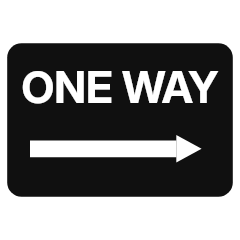
16. A driver disregards this sign and turns so as to travel against the direction it establishes. What is the immediate danger?
Show answer
Answer D: The driver will face traffic head on, because every lane comes the other way
Turning against the established direction puts the vehicle nose to nose with all the traffic on that street, which is why the mistake has to be corrected at once.
-
17. What does Nevada law allow a driver to do with a cellular phone while driving?
Show answer
Answer B: Use it for voice communication only with a hands-free accessory
Nevada bans handheld use of a wireless device for voice communication unless a hands-free accessory is used, and bans manual texting, reading, internet searching and other non-voice use outright.
-
18. How close to a fire hydrant may a vehicle be parked in a Nevada location where angle parking is permitted?
Show answer
Answer C: No closer than 20 feet
Nevada bans parking within 15 feet of a fire hydrant where parallel parking is permitted, and within 20 feet where angle parking is permitted.
-
19. A driver is following you far too closely and you have a turn coming up. How should you slow down for it?
Show answer
Answer B: Signal early and slow gradually well before the turn
Early signals and gentle braking give a tailgater the time and distance they have failed to leave for themselves.
-
20. Your light turns green, but a vehicle is still in the middle of the intersection. What should you do?
Show answer
Answer D: Wait until the intersection is clear before you move ahead
A green light means go only when the way is clear. Drivers already inside the intersection must be allowed to finish crossing.
-
21. Since marijuana became legal in Nevada, what blood limit applies to a person driving on a highway?
Show answer
Answer D: More than two nanograms of marijuana per milliliter of blood is unlawful
The Nevada Driver's Handbook states that it is unlawful to drive with more than two nanograms of marijuana per milliliter of blood, or five nanograms per milliliter of marijuana metabolite, even though possession is legal.
-
22. A flashing red arrow is displayed for your turning lane. What does it require?
Show answer
Answer D: Stopping, then turning when the way is clear
A flashing red arrow is treated like a stop sign for that movement: come to a full stop, then turn when it is safe and no one has to be cut off.
-
23. A Nevada driver under 18 gives a breath test result of .05 percent. How long is the license revoked?
Show answer
Answer D: 185 days
A Nevada driver under 18 whose test shows at least 0.02 percent but less than 0.08 percent has the license revoked for 185 days.
-
24. How close to the nearest rail of a railroad may a vehicle be parked in Nevada?
Show answer
Answer A: No closer than 50 feet
Nevada prohibits parking within 50 feet of the nearest rail of a railroad.
-
25. Why is repeatedly changing lanes to work through heavy traffic a poor idea?
Show answer
Answer A: It raises the crash risk and saves almost no time
Each lane change adds a conflict with another vehicle, and in congestion the lanes move at similar average speeds, so the gain is negligible.