
Nevada DMV Motorcycle Practice Test 53
- Questions25
- Correct to pass20
- Passing score80%
- Minimum age15 years 6 months
-
1. You have turned right into the nearest lane but you need the left lane soon. When should you move over?
Show answer
Answer A: After the turn is finished, once you have checked mirrors and blind spot
Complete the turn in the proper lane first, then make a normal lane change with mirror and blind spot checks once you are established on the new street.
-
2. How often should you check your mirrors while driving?
Show answer
Answer C: Every few seconds, so you always know what is around you
Traffic behind and beside you changes constantly. Frequent, brief mirror checks keep a picture of your surroundings current so nothing surprises you.
-
3. Four vehicles reach a four-way stop from all four directions at the same instant. How is the deadlock resolved?
Show answer
Answer C: Each driver yields to the vehicle on the right and they go one by one
Yielding to the right applies to every driver, so the group untangles itself as drivers take turns rather than moving together.
-
4. How can a Nevada rider obtain a Class M license without taking the DMV written and skills tests?
Show answer
Answer C: By completing a certified motorcycle safety course and bringing the certificate of completion to a DMV office
Nevada accepts a Motorcycle Safety Foundation certified course in place of the DMV written and skills tests, and the DMV will accept the certificate for up to one year after completion.
-
5. What does the Lights and Electrics step of T-CLOCS include?
Show answer
Answer A: The battery, the headlight, the brake light and the wiring
This step covers the battery and its terminals, the headlight, tail and brake lights, the turn signals, the switches, the mirrors and the wiring.
-
6. A large X with the letters R and R beside it is painted across your lane. What does it mean?
Show answer
Answer A: A railroad crossing lies a short distance ahead
The pavement marking repeats the advance warning for a grade crossing, and it is used on paved approaches where speeds are high or where gates are installed.
-
7. What is the PRIME position on a fuel supply valve used for?
Show answer
Answer D: To let fuel flow into the carburetor after the machine has stood unused
PRIME bypasses the normal vacuum control and lets fuel refill an empty carburetor, which helps a machine start after sitting for a long time.
-
8. Why should riding clothing have no loose flapping parts?
Show answer
Answer B: Loose cloth can catch on the machine, and flapping tires the rider
Loose fabric can snag on the controls, the chain or a wheel, and the constant flapping and noise wear the rider out over a long ride.
-
9. Why should riding boots come above the ankle?
Show answer
Answer C: The ankle is easily broken and is left bare by a low shoe
The ankle takes a lot of damage when a motorcycle goes down or a foot is trapped, and a low shoe leaves it completely unprotected.
-
10. For an alert driver, about how long is the reaction time once a hazard has been recognized?
Show answer
Answer A: About three quarters of a second
Reaction alone takes roughly three quarters of a second for an alert driver, and perception takes about as long again, so a second and a half of travel is added before the brakes bite.
-
11. In heavy stop-and-go traffic, why does using both lanes right up to a merge point help?
Show answer
Answer D: It stores the queue in two lanes, so the backup is shorter
Filling both lanes halves the length of the queue and keeps it away from the traffic upstream, which is why alternating at the merge point works better when traffic is slow.
-
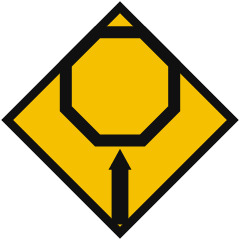
12. What is the driver expected to do after passing this sign?
Show answer
Answer A: Begin slowing so that a complete stop can be made at the intersection ahead
It is used where the control at the intersection stays hidden until late, so braking should begin here rather than at the stop line.
-
13. A pedestrian is crossing a wide four-lane street and has reached the lanes on the far side. When may you go on?
Show answer
Answer C: Only after the person has finished crossing the roadway
Waiting until the pedestrian has finished crossing is correct in every state and removes any doubt about how much clearance your state demands.
-
14. The car ahead of you slows down for no reason that you can see. Should you pull out and pass?
Show answer
Answer B: No, find out why it is slowing before you commit to the other lane
A driver usually slows for something, such as a turn, a hazard or a pedestrian, and that something is often exactly where your pass would take you.
-
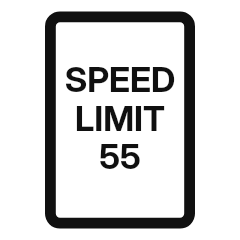
15. On a clear day with light traffic, a driver stays far below the maximum this sign sets. What can that cause?
Show answer
Answer B: Obstruction of the normal flow of traffic, which is prohibited in itself
Driving so slowly that other traffic is impeded is an offense in its own right when nothing about safety, weather or the road calls for it.
-
16. Compared with dry pavement, how much room does a vehicle need to stop on packed snow?
Show answer
Answer D: Several times as much
Grip on packed snow is a fraction of that on dry pavement, so stopping distance grows several times over. Antilock brakes help you steer, not stop shorter.
-
17. In most states, how far before a turn must your signal already be on in city traffic?
Show answer
Answer B: At least 100 feet, roughly the length of six or seven cars
Most states require the signal for at least 100 feet before a turn in city driving, which gives drivers behind you time to react before you slow; several require more at higher speeds.
-
18. The throttle sticks open and will not close when you roll it back. What should you do?
Show answer
Answer B: Squeeze in the clutch and shut the engine down with the cut-off switch
Pulling in the clutch cuts power to the rear wheel immediately, and the cut-off switch stops the engine without the rider letting go of the handlebars.
-
19. Why is it better for a passenger to hold the rider's waist or hips rather than the rider's shoulders?
Show answer
Answer A: Weight held low is less likely to disturb the rider's steering
Pulling on the shoulders feeds the passenger's movement straight into the rider's arms and handlebars, while a grip at the waist keeps that weight low and central.
-
20. You have just passed a vehicle on a two-lane road. When may you return to your lane?
Show answer
Answer B: When you can see the whole vehicle in your inside mirror
Seeing the entire vehicle you passed in your rearview mirror shows there is room to pull back in without cutting it off.
-
21. When should tire pressure be measured?
Show answer
Answer B: Before riding, while the tires are still cold
Riding heats the air inside a tire and raises the reading, so pressure is set cold to match the figure the manufacturer specifies.
-
22. A squirrel darts into your path a short distance ahead. What is normally the safest response?
Show answer
Answer C: Hold your line, brake as much as is safe, and accept hitting a small animal
Swerving without space, or crashing while braking, hurts the rider far more than a small animal does, so stay in your lane and slow as much as traction allows.
-
23. At 45 mph you look at a navigation screen for four seconds. Roughly how far do you travel unseeing?
Show answer
Answer D: About 260 feet
At 45 mph you cover roughly 66 feet a second, so four seconds on a screen is around 260 feet of road that you never looked at.
-
24. At night you are waiting to turn left and can see only the headlights of an approaching vehicle. Why should you allow a bigger margin?
Show answer
Answer D: Because lights alone make speed and distance hard to judge
With no other visual cues, two points of light give you very little information about how fast the vehicle is closing, so leave extra margin.
-
25. You are in the right-hand of two left-turn lanes and the vehicle beside you starts to drift toward your lane during the turn. What should you do?
Show answer
Answer B: Slow slightly, keep to your own lane and give the other vehicle room
Drivers commonly drift wide in dual turn lanes, so hold your own line, ease off and leave space rather than racing or crowding the other vehicle.