
Nevada DMV Motorcycle Practice Test 51
- Questions25
- Correct to pass20
- Passing score80%
- Minimum age15 years 6 months
-
1. An oncoming vehicle at night has its high beams on and you are being dazzled. Where should you look?
Show answer
Answer A: Toward the right edge of your lane
Looking toward the right edge line keeps you on course while sparing your eyes the worst of the glare. Slow down and do not retaliate with your own high beams.
-
2. Where is passing prohibited even when no line is visible?
Show answer
Answer D: On a curve or near the crest of a hill, at intersections and at railroad crossings
Passing is prohibited wherever your view of oncoming traffic is blocked or where vehicles may cross your path, which includes hills, curves, intersections and rail crossings.
-
3. You enter a corner faster than the turn can be taken. What is the most likely result?
Show answer
Answer A: The vehicle runs wide and may cross into another lane
Excess speed uses up the available grip, so the vehicle follows a wider arc than intended and drifts out of its lane.
-
4. Two left-turn lanes are marked at the intersection and you are in the left one. What must you do?
Show answer
Answer A: Stay in your own lane all the way around the turn
With dual turn lanes each driver must hold a lane through the whole turn and come out in the matching lane of the new street.
-
5. You want to turn left across the oncoming lane into a shopping center driveway. Who must you yield to?
Show answer
Answer B: Oncoming traffic and anyone using the sidewalk
A left turn into a driveway crosses both the oncoming lane and the sidewalk, so you give way to traffic and to pedestrians before completing it.
-
6. Besides a chemical test, what else supports an impaired driving charge?
Show answer
Answer B: The officer's observations of the driving and the driver
Weaving, slow responses, speech and balance observed by the officer are evidence in their own right, which is why a driver can be charged on behavior alone.
-
7. Which quality matters most in a face shield?
Show answer
Answer B: It resists penetration and is free of deep scratches
A shield has to stop objects thrown up from the road and stay clear enough for undistorted vision, and it needs some airflow so that it does not fog.
-
8. You are waiting in a left-turn lane at a green light when a fire engine with lights and siren comes toward you in the oncoming lanes. What should you do?
Show answer
Answer D: Hold your position and let the fire engine pass
Turning across the path of an approaching emergency vehicle is exactly what you must not do; stay put until it has gone by.
-
9. A curb sign reads 2 Hour Parking, 8 AM to 6 PM, Monday to Saturday. When may you stay longer than two hours?
Show answer
Answer A: Outside those hours and on Sundays
A time limit applies only during the days and hours printed on the sign; outside them the ordinary parking rules apply.
-
10. A ball rolls into the street from between parked cars ahead of you. What should you expect and do?
Show answer
Answer A: Expect a child to follow it and be ready to stop
A ball is usually followed by a child who is watching the ball and not the traffic. Slow down and be prepared to stop immediately.
-
11. You and an opposing driver reach a four-way stop at the same time and both of you are turning right. What should happen?
Show answer
Answer C: Both may turn at the same time into their own lanes
Two opposing right turns take drivers into different lanes without crossing, so both can proceed together once pedestrians are clear.
-
12. You are waiting to turn left across two oncoming lanes when a driver in the near lane stops and waves you through. What should you do?
Show answer
Answer D: Turn only after checking the far lane yourself
The waving driver cannot give away the right of way of the traffic in the second lane, which may not be stopping at all.
-
13. Halfway through a curve you realize you are going too fast. What is the best response?
Show answer
Answer C: Ease off the gas gently and look where you want to go
Easing off transfers a little weight to the front tires without upsetting the balance, and looking through the curve keeps your steering smooth.
-
14. Cones and drums mark a shifted lane through a work zone. What should you do?
Show answer
Answer A: Follow the path that they mark and stay inside it
Channelizing devices define the temporary travel path, and the space on the other side of them belongs to the workers.
-
15. At night you are judging your distance from the rider ahead by their tail light. What is the risk?
Show answer
Answer A: A single small light gives a poor sense of how far away it really is
Distance is very hard to judge from one small light in the dark, so riders should leave extra space rather than trust the impression the light gives.
-
16. You are about to pass another vehicle at night with your high beams on. What should you do?
Show answer
Answer C: Switch to low beams as you come up behind it and while you are alongside
High beams shining into the mirrors of the vehicle ahead blind the very driver whose reaction you depend on during the pass.
-
17. What is the most common cause of rear-end collisions?
Show answer
Answer C: Following too closely to stop in time
A driver who leaves too little space has no room to perceive, react and brake when the vehicle ahead slows, which is why space management prevents rear-end crashes.
-
18. A raised area crosses the roadway and carries a series of white markings on its face. What are those markings for?
Show answer
Answer A: To make the hump visible so drivers slow for it
Speed hump markings warn drivers that the pavement rises, which matters most at night or when the hump is in shadow.
-
19. In a work zone a flagger signals you to stop, but the sign beside the road says the lane is open. What should you do?
Show answer
Answer C: Obey the flagger
A flagger controls the work zone in real time and the instruction outranks the signs and markings, which cannot reflect what is happening at that moment.
-
20. Rain is falling and the outside temperature reads close to 32 degrees Fahrenheit. Why is that dangerous?
Show answer
Answer A: The rain can freeze on contact and glaze the road with ice
Near freezing, rain landing on cold pavement can turn to a glaze of ice almost at once, so a road that looks merely wet may have no grip at all.
-
21. Your passenger has ridden on other people's motorcycles before. What should you do before setting off?
Show answer
Answer A: Brief them anyway, because your machine and your instructions differ
Handholds, footrests, exhaust position and the signals a rider uses all vary from machine to machine, so every passenger is briefed on the machine they are about to ride on.
-
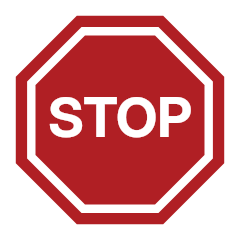
22. A driver slows to walking pace at this sign, never stops rolling and eases into the intersection. How is that treated?
Show answer
Answer B: It is a violation, because the vehicle never came to a complete halt
What is required is a full halt with the wheels no longer turning, so slowing down, however carefully, does not satisfy it.
-
23. You have a green light and are turning right. Pedestrians are stepping off the curb into the crosswalk you are about to cross. What should you do?
Show answer
Answer B: Wait and let them cross before completing your turn
A green light does not release a turning driver from yielding to pedestrians already in the crosswalk of the street being entered.
-
24. You are turning left at an intersection just beyond the crest of a hill. What is the added risk?
Show answer
Answer B: Oncoming vehicles appear with very little warning and close quickly
A crest hides approaching traffic until it is close, so the gap you thought was empty can fill in the time the turn takes.
-
25. What is the friction zone of the clutch?
Show answer
Answer A: The range of lever travel where power starts to reach the rear wheel
Easing the clutch lever into the friction zone lets the engine drive the rear wheel gradually, which is what makes a smooth start from a stop possible.