
Nevada DMV Motorcycle Practice Test 45
- Questions25
- Correct to pass20
- Passing score80%
- Minimum age15 years 6 months
-
1. Why is dusk one of the harder times of day to drive?
Show answer
Answer B: The failing light blurs shapes into the background
In fading light there is not enough contrast to pick objects out, yet it is not dark enough for headlights to do the work, so pedestrians and cyclists disappear.
-
2. How should a riding jacket fit?
Show answer
Answer B: Snug at the neck, wrists and waist so that it cannot balloon open
A jacket closed at the openings stays in place in a fall and does not flap in the wind, which is both tiring and distracting.
-
3. A yellow diamond in which one line joins another at an angle warns that
Show answer
Answer B: traffic from another roadway will merge into the driver's lane ahead
The merge sign warns that another traffic stream will join the same lane ahead, so drivers on both roadways must adjust speed and spacing.
-
4. In normal operation, which indication always comes between a green and a red on the same signal face?
Show answer
Answer C: A steady yellow
The yellow change interval must follow every green or green arrow, so a signal can never jump straight from green to red.
-
5. A sign warns that your exit leaves from the left side of the freeway. What should you do?
Show answer
Answer D: Move into the left lane in good time before you reach the exit
Left-hand exits are unusual, which is exactly why they are signed well in advance and why the lane changes should be finished early.
-
6. How should a passenger behave through a turn?
Show answer
Answer B: Look over the operator's shoulder in the direction of the turn and avoid sudden movement
Looking over the operator's shoulder into the turn keeps the passenger aligned with the motorcycle, and avoiding sudden movement prevents unexpected changes in balance.
-
7. You reach a four-way stop after another driver has already stopped there. What should you do?
Show answer
Answer D: Let the driver who stopped first proceed before you go
At a four-way stop the vehicles proceed in the order they arrived, so a driver who stopped before you goes first.
-
8. Your front wheel drops off the edge of the pavement onto a lower shoulder. What is the safest way back?
Show answer
Answer D: Ride straight, slow down, then turn back sharply enough to cross the edge
Trying to climb a raised pavement edge at a shallow angle lets the tire slide along it, so the rider settles first and then crosses the edge at a sharp angle.
-
9. Where does loose sand and gravel most often collect on a paved road?
Show answer
Answer D: Along the edges of the road and on curves and highway ramps
Traffic sweeps loose material toward the outside of the travel path, so it builds up at the road edges and on curves and on entrance and exit ramps.
-
10. You are making a U-turn at a signal on a green left arrow. Who must you still watch for?
Show answer
Answer D: People in the crosswalk you will cross as you come around
Even a protected arrow does not clear the crosswalk, and a U-turn sweeps across a crosswalk that pedestrians may already be using.
-
11. What is a marked loading zone for?
Show answer
Answer A: Loading and unloading only, not for general parking
A loading zone is reserved for actively loading or unloading goods or passengers; leaving a vehicle there for other reasons is a parking violation.
-
12. An ambulance with lights and siren is coming toward you on an undivided two-lane road. What must you do?
Show answer
Answer A: Pull to the right edge and stop until it passes
On an undivided road, drivers in both directions clear the way, pulling to the right edge and stopping.
-
13. When does Nevada law require headlights to be switched on?
Show answer
Answer C: Half an hour after sunset to half an hour before sunrise, and below 1,000 feet visibility
Nevada requires headlights from a half hour after sunset until a half hour before sunrise, when there is insufficient light, whenever people or vehicles cannot be seen at 1,000 feet, and when a traffic control device directs it.
-
14. Why is passing another vehicle a bad idea in dense fog?
Show answer
Answer C: You cannot see far enough ahead to know the passing lane is clear
A pass needs a clear view of the road well beyond the vehicle you are overtaking, and fog takes exactly that away.
-
15. Why is it worth planning your route before a long drive?
Show answer
Answer B: So that you are not reading a map or a screen while the car is moving
A driver who knows the route is not navigating at the wheel, which is one of the commonest sources of distraction.
-
16. When is a driver at the highest risk of falling asleep at the wheel?
Show answer
Answer B: Late at night, early morning and mid afternoon
The body clock produces its deepest dips in alertness in the small hours and again in the middle of the afternoon, and crash records follow those dips.
-
17. A police officer in the intersection raises a hand toward you although your signal is green. What should you do?
Show answer
Answer B: Stop and wait for the officer to wave you on
An officer directing traffic overrides signals and signs, and drivers must follow the officer even when the light says otherwise.
-
18. At a freeway exit ramp, this sign normally backs up which other regulatory sign posted nearer to the ramp terminal?
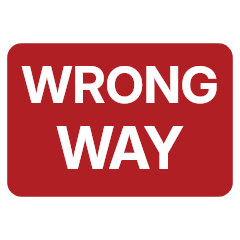
Show answer
Answer D: The sign that forbids entering that roadway at all
The two work as a pair at ramp terminals: one keeps drivers from turning in, and this one sits farther along to catch a driver who has already entered.
-
19. A driver ahead brakes for no reason you can see, again and again. What should you do?
Show answer
Answer B: Increase your following distance and be ready for yet another stop
Unexplained braking tells you the driver is unsure or distracted, so the safe answer is more room, not less.
-
20. How can you check that you are keeping a safe following distance?
Show answer
Answer A: Count at least three seconds between the vehicle ahead passing a fixed object and your reaching it
Pick a fixed roadside object, start counting when the vehicle ahead passes it and make sure at least three seconds elapse before you reach it, adding more time in poor conditions.
-
21. Which family of signs normally uses a rectangle that is wider than it is tall?
Show answer
Answer B: Guide signs, which name routes and destinations
Guide signs are laid out as horizontal rectangles because they have to carry route numbers, place names and distances side by side.
-
22. A large electronic advertising sign beside the road catches your eye. What should you do?
Show answer
Answer A: Glance briefly and return your eyes to the road
Bright changing displays are designed to hold attention, so treat them like any roadside object and give them no more than a brief glance.
-
23. In the code that governs pavement markings, what does a double line stand for?
Show answer
Answer B: A maximum restriction
The marking code is consistent: a double line means the strongest restriction, a solid line discourages or forbids crossing, and a broken line is permissive.
-
24. A yellow diamond showing a truck is posted beside a quarry entrance. What is it warning about?
Show answer
Answer A: Trucks turning onto the highway from that entrance
A truck crossing or trucks entering sign is used where heavy vehicles pull onto the road from a site, and they accelerate slowly once they are on it.
-
25. You are leaving a private driveway and entering a public street. What are you required to do?
Show answer
Answer B: Stop and yield to traffic on the street and to pedestrians on the sidewalk
A driver entering a roadway from a driveway, alley or private road must stop and yield to traffic on the roadway and to pedestrians on the sidewalk being crossed.