
Nevada DMV Motorcycle Practice Test 13
- Questions25
- Correct to pass20
- Passing score80%
- Minimum age15 years 6 months
-
1. A deer crosses the road in front of you and disappears into the trees. What should you expect?
Show answer
Answer B: That other deer are likely to follow it across the very same stretch of road
Deer usually move in groups, so one crossing the road is a warning that more may follow.
-
2. You are traveling at 55 mph and see a vehicle ahead moving at about 15 mph. What is the hazard?
Show answer
Answer A: You reach it far sooner than you expect
At a 40 mph difference you cover the gap in a few seconds, which is why drivers strike slow vehicles they saw in plenty of time.
-
3. May you stop in a marked bicycle lane to let a passenger out?
Show answer
Answer B: No, stopping there forces riders into the traffic lane
A vehicle stopped in a bike lane pushes riders out into moving traffic, which is exactly what the lane exists to prevent.
-
4. How should a group decide how often to stop for fuel?
Show answer
Answer A: By the range of the machine with the smallest fuel tank
Planning around the smallest tank keeps the group from splitting up when one rider has to leave the route to look for fuel.
-
5. Which action makes a wobble worse instead of better?
Show answer
Answer A: Braking or accelerating to try to ride out of it
Braking or adding power during a wobble can amplify it. Close the throttle gradually, hold the bars firmly and let the speed fall until the machine settles.
-
6. Where is a U-turn most clearly unsafe and generally prohibited?
Show answer
Answer D: On a curve or near a hill crest, where other drivers cannot see you
U-turns are barred where approaching drivers cannot see you in time, such as on a curve or near the top of a hill.
-
7. Along a highway the reference markers count upward as you travel. Where does the numbering normally begin?
Show answer
Answer C: At the southern or western edge of the state
Mileage numbering starts where the route enters the state from the south or the west, so rising numbers tell a driver which way they are heading.
-
8. When should a rider avoid a tinted face shield or tinted goggles?
Show answer
Answer C: At night and in other low light conditions
A tint cuts the amount of light reaching the eyes, which makes hazards much harder to pick out once daylight fades.
-
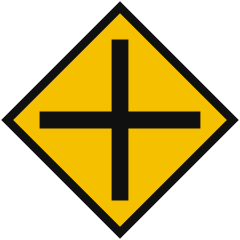
9. Does this sign settle who has the right-of-way at the intersection ahead?
Show answer
Answer D: No, it only gives notice of the intersection; the control there decides priority
A warning prepares the driver for what is coming but grants no priority, so whatever stop control, yield control, signal or right-of-way rule applies at the intersection is what decides.
-
10. Your phone is in a mount on the dashboard rather than in your hand. What is true?
Show answer
Answer B: It still takes your eyes and mind off the road
A mount solves the hand problem but not the eye or the mind problem, and reading or tapping a mounted screen costs the same seconds of attention.
-
11. Your vehicle has broken down at night on a rural road and your phone has no signal. What is the safest thing to do?
Show answer
Answer C: Stay with the vehicle, keep the hazard lights on and wait for help
A lit vehicle is far easier to find than a person walking in the dark, and running the engine while you sleep risks carbon monoxide.
-
12. What do two solid yellow lines down the middle of a two-way road mean?
Show answer
Answer D: Passing is prohibited for traffic in both directions
A double solid yellow line marks a two-direction no-passing zone, so neither direction may cross it to overtake another vehicle.
-
13. After a crash, what information should you exchange with the other driver?
Show answer
Answer B: Name, address, driver license, vehicle registration and insurance details
Identification, registration and insurance information are what the other party and the insurers need. Sensitive financial details are never required.
-
14. What is the correct way to secure a load on a motorcycle?
Show answer
Answer C: Fasten it with elastic cords using several attachment points and check it at every stop
Several attachment points hold the load tight so it cannot shift or fall into the wheel or the chain, and checking at stops catches a load that has worked loose.
-
15. Your face shield develops a crack across the middle. What should you do?
Show answer
Answer D: Replace the shield, because a crack scatters light and can fail
A cracked shield distorts your view, scatters light badly at night and can break apart in an impact, so it should be replaced rather than repaired.
-
16. A driver who is passing you cannot complete the pass because a vehicle is coming. What should you do?
Show answer
Answer C: Ease off the accelerator and make room for them to drop back in
The only place for the passing vehicle to go is the gap behind you, and easing off opens that gap immediately.
-
17. How should a rider take curves while carrying a passenger?
Show answer
Answer A: More slowly than when riding alone
The extra weight raises the center of gravity and makes the motorcycle respond more slowly, so curves have to be taken at a lower speed.
-
18. It is dusk and a jogger in dark clothing is running along the edge of the road. What should you do?
Show answer
Answer D: Slow down and scan the edges of the road
Dusk is the hardest light for spotting people, and dark clothing removes most of your warning, so lower speed and a careful scan of the roadsides are the answer.
-
19. You are turning left from a one-way street onto another one-way street. Which lane should you use?
Show answer
Answer B: Turn from the far left lane into the far left lane of the new street
The general turning rule is to turn from the lane nearest the direction of the turn into the nearest lane of the new roadway, which on a one-way to one-way left turn means far left to far left.
-
20. When should a rider add a layer on a ride that is turning cold?
Show answer
Answer D: Before you start to feel cold, at the next convenient stop
Once a rider is chilled it takes a long time to warm up again, and cold hands and slowed reactions cost control, so add layers before the cold takes hold.
-
21. You are very angry after an argument and about to drive. What should you know?
Show answer
Answer A: Strong emotions can impair judgment and attention much like alcohol
Anger, grief and stress pull attention inward and encourage risk taking. Give yourself time to settle down before getting behind the wheel.
-
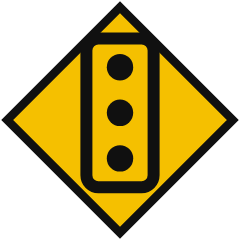
22. Why would this sign be installed on an approach?
Show answer
Answer B: Because the signal cannot be seen from far enough back for a driver to react in time
Advance notice of a signal is used where a crest, a curve, trees or a building keep the signal heads out of view until a driver is already too close to stop comfortably.
-
23. You are turning left from a two-way street onto a one-way street. Which lane should you enter?
Show answer
Answer C: The first lane open to traffic on the left side of the one-way street
Turn left from the lane closest to the center line and finish in the first available lane on the left of the one-way street, then change lanes if you need to.
-
24. You are approaching the entry of a modern roundabout. Who must you yield to?
Show answer
Answer C: Traffic already circulating in the roundabout, which approaches from your left
Traffic in a United States roundabout circulates counterclockwise, so drivers entering must look left and yield to vehicles already in the circulating roadway.
-
25. What is the main reason a rider should keep a generous following distance on a rough, broken road?
Show answer
Answer B: So the rider can see and plan for holes and broken pavement in time to react
The vehicle ahead hides the pavement, so extra space gives you time to spot a hole or a broken edge and to choose a path around it.