
Nevada DMV Permit Practice Test 50
- Questions25
- Correct to pass20
- Passing score80%
- Minimum age15 years 6 months
-
1. You feel dizzy and get a headache while driving with the windows closed. What could be the cause and what should you do?
Show answer
Answer D: An exhaust leak letting carbon monoxide into the cabin, so open the windows and stop to get fresh air
Carbon monoxide is colorless and odorless, and headache, dizziness and drowsiness are early signs. Get fresh air at once and have the exhaust system inspected.
-
2. Your steering suddenly feels light and unresponsive as you drive through standing water. What should you do first?
Show answer
Answer A: Ease off the accelerator and keep the steering wheel pointed straight
Those symptoms mean the tires are riding on a film of water, and gently lifting off the accelerator lets them settle back onto the pavement. Hard braking or sudden steering while hydroplaning can start a skid.
-
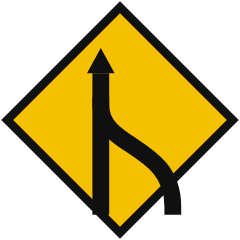
3. What does this sign warn a driver about?
Show answer
Answer A: Traffic from another roadway will enter the same lane ahead
Two traffic streams come together into one lane beyond this point, so drivers on both roadways have to adjust speed and spacing to fit together.
-
4. You are crossing a divided highway with a wide median. How should you treat the two roadways?
Show answer
Answer D: As two intersections, waiting in the median only when your vehicle fits
Each roadway of a divided highway is a separate intersection, and you should wait in the median only if it is long enough to hold your vehicle clear of both roadways.
-
5. A pedestrian waiting at a curb faces a steady upraised hand. What does that indication mean?
Show answer
Answer A: Do not start to cross in that direction
A steady upraised hand forbids entering the crosswalk, while a flashing hand only forbids starting a new crossing.
-
6. You and the driver facing you both have stop signs at a two-way stop. You are going straight and that driver is turning left. Who has the right of way?
Show answer
Answer B: You do, and the turning driver must wait
Between two opposing drivers who both stopped, the one going straight goes first and the left-turning driver yields.
-
7. Why does a dirty windshield matter much more at night than during the day?
Show answer
Answer C: Dust and streaks scatter oncoming light and increase glare
Film and streaks on the glass spread every oncoming headlight into a star of glare, so clean the inside as well as the outside before a night trip.
-
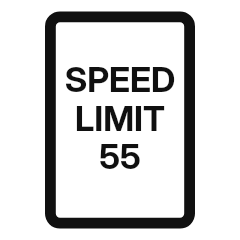
8. A driver passes this sign on an open road. Over what stretch does the figure it sets stay in force?
Show answer
Answer A: From the sign onward, in every lane, until another sign sets a different figure
The figure governs the road from the sign onward and binds every lane, and it stays in force until a later sign sets a different one.
-
9. Why do many crashes happen on routes the driver knows very well?
Show answer
Answer D: Familiar roads let attention slip into routine
When a route is automatic the mind wanders and hazards get missed, which is why a well known road deserves the same attention as a strange one.
-
10. You are approaching a narrow bridge where the road has one lane in each direction and no shoulder. What should you do about passing?
Show answer
Answer B: Do not pass on or near the bridge
A narrow bridge gives neither vehicle anywhere to go, so passing is prohibited there in the same way as on a hill or in a tunnel.
-
11. Your light turns green, but a vehicle is still in the middle of the intersection. What should you do?
Show answer
Answer D: Wait until the intersection is clear before you move ahead
A green light means go only when the way is clear. Drivers already inside the intersection must be allowed to finish crossing.
-
12. A driver is following you far too closely. What is the best response?
Show answer
Answer D: Increase your own following distance and let the driver pass when it is safe
More room ahead of you means you can slow gradually instead of braking hard, which reduces the chance of being struck from behind, and letting the driver by removes the problem entirely.
-
13. Which speed limit does the Nevada handbook give as typical for business and residential areas?
Show answer
Answer C: 25 mph
The Nevada handbook lists 25 mph for business and residential areas and for some school zones, with 15 mph reserved for the tightest school zones.
-
14. Whose name must appear on the liability policy covering a Nevada registered vehicle?
Show answer
Answer C: The registered owner must be a named insured
Nevada requires the registered owner to be a named insured, and a name on the registration must match a named insured before NV LIVE will validate the coverage.
-
15. Reaching for a drink in the cup holder is which kind of distraction?
Show answer
Answer A: Manual and visual at the same time
Your hand leaves the wheel and your eyes flick down to find the cup, so a task that feels trivial takes away two of the three things driving needs.
-
16. What does a tire with worn tread do on a wet road?
Show answer
Answer B: It loses grip and it hydroplanes at a lower speed than a good tire
Tread grooves carry water away from the contact patch, and a worn tire cannot do that, so it floats on the water sooner.
-
17. Smoke from a nearby fire is drifting across the highway. What should you do?
Show answer
Answer C: Slow down, use low beams, and close the windows and vents
Smoke cuts visibility like fog and can make your eyes water. Low beams, a much lower speed and closed vents protect both your view and the air in the car.
-
18. Which steering method gives the most control when you must turn the wheel a long way at low speed?
Show answer
Answer C: Hand over hand, feeding the wheel from one hand to the other
Hand over hand keeps both hands on the wheel through a large turn, so you never lose the ability to correct quickly.
-
19. You are hosting a party and a guest who has been drinking wants to drive home. What should you do?
Show answer
Answer D: Stop serving and arrange a ride or a bed
Only time removes alcohol, so a host who wants to prevent a crash has to remove the driving, not try to speed up sobering that cannot be sped up.
-
20. You are waiting to pull out of a driveway when a bicyclist comes along the bike lane in front of you. What must you do?
Show answer
Answer D: Wait until the bicyclist has gone past
A driver leaving a driveway yields to everything already on the road, and a bike lane is part of the roadway.
-
21. A bicyclist is riding in the middle of a narrow travel lane ahead of you. What is the correct response?
Show answer
Answer D: Slow down and wait until you can pass with wide clearance, changing lanes if needed
A bicyclist has the same right to use the lane as a driver, and a narrow lane may not leave safe passing room, so wait for a gap that lets you move over and pass with a wide margin.
-
22. Who must co-sign a Nevada driver license application for an applicant under 18, and what does signing mean?
Show answer
Answer D: A parent with custody or legal guardian, who shares liability for damages
A parent with custody, a legal guardian or another person authorized by NRS 483.300 must co-sign, and the co-signer shares liability for damages caused by the minor's negligence or willful misconduct while driving.
-
23. At the scene of a crash you were part of, what are you required to do besides stopping?
Show answer
Answer B: Give your name, your address and vehicle details, and help anyone who is hurt
Every state requires drivers involved in a crash to identify themselves and to render reasonable aid to anyone injured.
-
24. You are waiting to turn and the traffic ahead has stopped. Where must you not come to rest?
Show answer
Answer D: On the crosswalk, which people need in order to cross the street
Stopping on a crosswalk forces pedestrians out into the traffic lanes to get around you, so you hold back before it instead.
-
25. The brake warning light stays on even though the parking brake is fully released. What does it indicate?
Show answer
Answer B: A possible brake system problem, so have the brakes checked promptly
The brake warning light also signals low brake fluid or a failure in one part of the hydraulic system. Do not ignore it, because braking may be reduced.